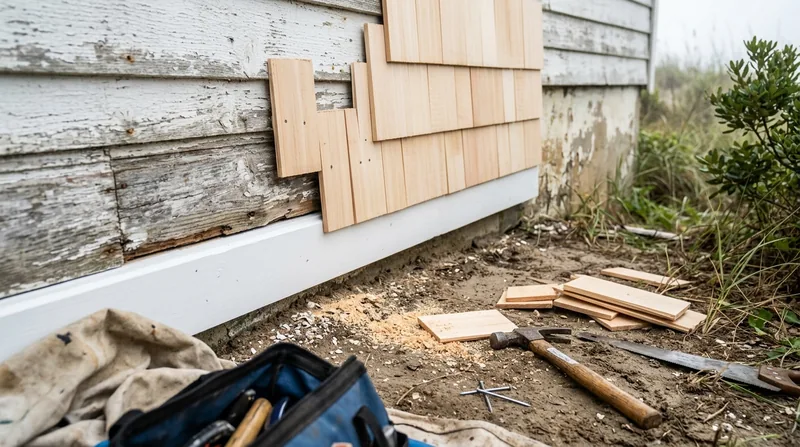




Virginia Beach's salt air and humid subtropical summers create ideal conditions for wood rot in residential framing, siding, and exterior trim. The flat coastal terrain, live oak and loblolly pine canopy, and steady moisture from the Chesapeake Bay and Atlantic Ocean mean that wood decay is not a rare problem here, it's a structural reality that homeowners face routinely. Whether your home is a mid-century beach cottage near the Oceanfront, a elevated Sandbridge coastal home on tall pilings, or a brick ranch from the Navy-boom 1950s across Great Neck or Kempsville, wood rot and dry rot repair is a legitimate maintenance issue that demands honest assessment and solid carpentry. We cut out decayed wood, treat what's sound, and rebuild with rot-resistant lumber. That's a permanent repair, not a cosmetic patch. Call us at (757) 392-0128 for a free estimate, or read on to understand what rot is, why it happens here, and how we fix it.
Why Wood Rot Is a Virginia Beach Problem: Salt, Humidity, and Time
Rot doesn't happen overnight. It starts when wood stays wet or damp long enough for fungal spores to germinate and feed on the cellulose. In Virginia Beach, the combination of salt spray, high summer humidity, occasional standing water after storms, and the shade cast by mature oak and pine creates pockets where wood moisture climbs and stays. Sill plates where the framing sits on the rim joist, fascia and soffit at the eave line, exterior door jambs, deck framing, and porch subfloors are the first casualties. Once decay takes hold, it spreads quietly through the grain, weakening the wood's load-bearing capacity and creating a pathway for further damage.
- Salt air accelerates wood decay in coastal areas, particularly in siding and trim within a half-mile of the Oceanfront or Sandbridge shoreline.
- Humidity and shade from mature tree canopy trap moisture against exterior wood, creating the exact environment fungal rot requires.
- Standing water after summer thunderstorms or nor'easters soaks subfloors, floor joists, and basement rim joists in low-lying areas.
- Deferred maintenance and missed caulking or sealant failures allow water penetration into framing at windows, doors, and trim seams.
Catching rot early and repairing it stops the decay in place. Waiting allows it to migrate deeper into structural members, making repair costlier and more extensive.
Key info: A rotted sill plate under a brick ranch in Great Neck or a decayed floor joist in a Sandbridge cottage can go unnoticed for years until a sagging floor or soft spot in the subfloor signals the problem. By then, the repair often requires more lumber replacement than early intervention would have needed. We inspect, assess the extent, and propose repair or replacement based on what the wood actually justifies.
For more on related structural damage, see our floor joist and subfloor repair service page.
How We Repair Wood Rot in Virginia Beach: Assessment, Removal, and Rebuild
Our process is straightforward and transparent. We arrive on site, visually inspect the affected area, probe suspect wood with a screwdriver or awl to gauge softness and decay depth, and take photographs and measurements. If you have a recent pest inspection report documenting termite or carpenter ant damage, we work from that baseline. We then explain what we find, estimate the scope of removal and replacement, and outline the repair approach before we cut anything.
- We cut out all visibly decayed wood using hand tools and reciprocating saws, working carefully to preserve sound framing around the damage.
- We treat exposed sound wood with a wood preservative to arrest any incipient decay and reduce future moisture uptake.
- We rebuild using pressure-treated lumber, redwood, or Douglas fir, depending on the location and exposure level of the repair.
- We seal all new wood joints and end grain with exterior caulk or sealant to prevent water entry at the repair seam.
- We restore trim, siding, or finish carpentry to match the original appearance and protect the repair from future weather exposure.
The result is a durable repair that addresses the cause of the decay and restores structural integrity to the affected member.
Example: A homeowner in Thoroughgood noticed soft spots in the fascia and soffit where water was backing up under the gutter. We removed the affected redwood fascia, replaced the decayed portion with new pressure-treated lumber, re-pitched the gutter slightly, and installed new soffit vents to improve attic ventilation. The repair took one day, cost under $1,200, and eliminated the moisture source. See our fascia and soffit repair page for more detail on exterior trim work.
Repair Methods and When We Use Them
| Approach | Description | Best for |
|---|---|---|
| Localized removal and sistering | Cut out the decayed section, treat the sound wood, and sister a new pressure-treated member alongside the existing framing to restore load capacity. | Partial rot in a floor joist, rim joist, or stud where the member is still mostly sound. |
| Complete member replacement | Remove the entire rotted joist, stud, or sill plate and install a new pressure-treated or rot-resistant lumber member in its place. | Extensive decay affecting the majority of a single framing member, or sill plates under load-bearing walls. |
| Trim and exterior casing replacement | Remove rotted fascia, soffit, exterior door casing, or window trim, and install new pressure-treated or exterior-grade lumber with proper sealant. | Surface rot in exposed trim and casing where structural framing is unaffected. |
| Preventive moisture control | Install or improve gutter drainage, re-pitch roof drip edges, caulk window and door seams, and improve attic or crawlspace ventilation to reduce future moisture intrusion. | Early-stage rot or high-risk areas where moisture is the root cause and prevention is more cost-effective than repeated repairs. |
Wood Rot and Dry Rot Repair Cost in Virginia Beach: What to Expect
Wood rot repair costs depend on the extent of decay, the location of the damage, the type of lumber needed, and access to the affected area. A small, localized repair in accessible trim or siding may run $650 to $1,200. Larger jobs involving floor joists, sill plates, or structural framing can easily exceed $2,500 to $5,000 or more. The best way to know what your specific repair will cost is to get a free, on-site estimate from a carpenter who can see the damage and assess the scope in person.
- Small, localized trim or fascia rot repair typically starts at $650 and covers removal, treatment, and replacement of up to 8 linear feet of exterior trim.
- Moderate rot affecting a single floor joist or rim joist section usually runs $1,500 to $2,500, depending on whether sistering or full replacement is needed.
- Large-scale repairs involving multiple joists, sill plates, or load-bearing wall members require an on-site assessment and a detailed estimate before work begins.
- Moisture control improvements, such as improved gutter drainage or ventilation upgrades, are often bundled with the repair and factored into the total cost.
We provide a free, no-obligation estimate within 24 hours. Call (757) 392-0128 or visit our pricing page for more detail on what different repair scopes include and the factors that move costs up or down.
Wood Rot and Dry Rot Repair Near Me: What Virginia Beach Homeowners Should Know When Hiring a Carpenter
Not all carpenters approach rot the same way. Some push for full replacement when repair would work. Others lack the patience or skill to cut out decay cleanly and rebuild properly. When you're hiring, look for a carpenter who listens, explains the pathology, shows you the damage, and proposes repair before replacement. Ask for references from past rot repair jobs. Confirm that the carpenter is fully insured and carries general liability and workers compensation coverage. Get 2 or 3 estimates so you can compare approaches and pricing.
- Ask the carpenter to explain what caused the rot and what moisture control steps will prevent it from recurring in that spot.
- Request photographs of the decay and the repair, so you understand the scope and can verify that the work was done thoroughly.
- Confirm whether the repair requires a permit from the Virginia Beach Building Department, particularly if structural framing is involved.
- Check whether your homeowners insurance will cover the repair and whether documentation from the carpenter will help support a claim.
- Ask about warranty or guarantee on the repair materials and workmanship, and get it in writing in your contract.
We are fully insured, licensed as a Virginia Class B Contractor (DPOR) for Building and RBC work, and have been in business since 2016. We are happy to provide references and answer any questions about our approach. Call us at (757) 392-0128 or contact us for a free estimate.
Wood Rot & Dry Rot Repair in Virginia Beach: Pricing Guide
| Service | Price | Details |
|---|---|---|
| Small trim or fascia rot repair | Starting at $650 | Removal and replacement of up to 8 linear feet of exterior trim or fascia with pressure-treated lumber and sealant |
| Single floor joist or rim joist repair | Starting at $1,500 | Sistering or partial replacement of one joist section, treatment of sound wood, and restoration of subfloor or rim connections |
| Sill plate or multi-member structural repair | Starting at $2,500 | Removal and replacement of rotted sill plate, rim joist, or multiple studs, often requiring temporary support and possible permit |
| Large-scale or complex repair | On estimate | Extensive rot affecting multiple structural members, load-bearing wall sections, or repairs requiring engineered assessment or structural support |
| Travel and estimate | Free | No mileage fee within Virginia Beach and surrounding areas, response within 24 hours at (757) 392-0128, no obligation to book |
Indicative pricing, the exact cost depends on square footage, finish, and site access. Free personalized estimate within 24h at (757) 392-0128.


